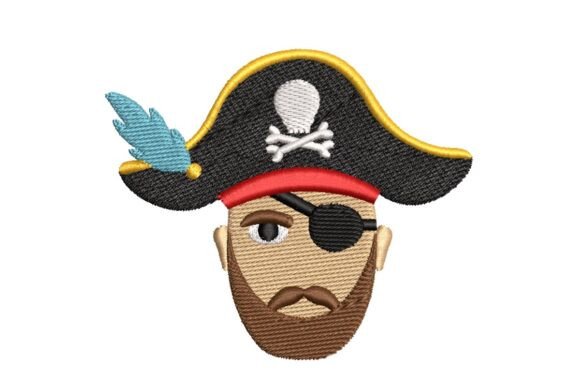
Pirate Face Patch: A Designer’s Real-World Embroidery Review
First Impression: Bold, Playful, and Instantly Recognizable
When I opened the Pirate Face Patch embroidery file, my first thought wasn’t “cute” or “quirky”—it was “this will land.” The design leans into confident simplicity: a centered pirate face with strong silhouettes—the eyepatch, the feathered hat, the exaggerated grin. There’s no fussy shading or micro-detailing, which is smart. This isn’t a portrait; it’s a statement. It reads clearly at 3.5 inches wide on a tote bag, and still holds up at 2 inches on a baby onesie cap. That balance—between personality and practicality—is rare in themed machine embroidery designs.
Where It Shines: Real Projects, Real Customers
I tested Pirate Face Patch on three real items from my current craft business pipeline: a cotton canvas tote for a local kids’ bookstore, a midweight unisex sweatshirt for a summer camp fundraiser, and a set of linen tea towels for a boutique’s pirate-themed nursery collection. On all three, it stitched cleanly and read well—even at speed. The satin stitch outlines around the hat brim and eyepatch gave crisp definition without snagging. The fill stitches in the face and feather stayed dense but breathable, never puckering on the sweatshirt’s brushed interior.
What surprised me most was how well it translated across audiences. Parents loved it on baby embroidery—not too scary, not too cartoonish. Teens responded to its cheeky confidence on custom apparel. And small shop owners appreciated that it didn’t compete with branding; it *supported* it. As an embroidered patch sewn onto a denim jacket or apron, it added handmade charm without overwhelming the garment’s function or fabric texture.
Design Personality Meets Practical Use
- Tote bag design: Anchors the front panel beautifully—no need for extra text or borders.
- Sweatshirt embroidery: Works best centered just below the collarbone; avoids stretching distortion across the chest.
- Baby embroidery: Scales down cleanly to 1.75" with minimal loss of expression—ideal for onesies and burp cloths.
- Holiday embroidery: Paired with navy or gold thread, it adds playful contrast to Christmas stockings or Easter burlap banners.
- Commercial embroidery: Holds up under moderate production volume—no nested jump stitches or fragile anchor points.
Where to Pause—and Why
Pirate Face Patch isn’t magic. It’s a well-built machine embroidery design, not a universal fix. Here’s where attention matters:
- Thin or stretchy fabric: Skip direct stitching on lightweight knits—use tear-away + cut-away stabilizer combo, or turn it into an embroidered patch first.
- Curved surfaces (like caps): The shape is wide and flat—best suited for front panels, not curved crowns unless resized and re-digitized.
- Dark fabric: Test your thread colors. The feather detail relies on subtle tonal shifts—if you’re using black thread on black fabric, that feather disappears. Opt for charcoal or deep navy instead.
- Frequent washing: Avoid heavy satin stitch over large areas on items like kitchen towels—reinforce with a light running stitch outline if durability is critical.
- Small hoop sizes (under 4x4"): You’ll need to split or resize—check the original file dimensions before loading.
What It Adds to Your Handmade Product—Beyond the Stitch
This isn’t just about whether the design sews out cleanly (it does). It’s about what it communicates to the person holding your finished product. A well-executed Pirate Face Patch says “thoughtful,” “playful,” and “professionally made”—even when stitched by hand at home. For Etsy sellers, that impression directly affects perceived value and repeat purchases. For small shop owners, it strengthens brand consistency across seasonal collections. And for gift-givers? It makes personalization feel effortless and joyful—not forced or generic.
I’ve watched customers pause at craft fair booths when they see this design on a pillow cover or apron. Not because it’s flashy—but because it feels *intentional*. That’s the quiet power of a strong embroidery file: it doesn’t shout. It invites.
Designer Notes You Can’t Skip
Before you load Pirate Face Patch into your machine or list it as part of a digital embroidery bundle, take five minutes to do these:
- Run a test on scrap fabric matching your project’s weight and stretch.
- Check thread color contrast—especially in the feather and eyepatch details—against both light and dark backgrounds.
- Review stitch density in the face area; if it feels overly heavy for your fabric, adjust underlay or reduce density slightly.
- Confirm hoop size compatibility—don’t assume it fits your smallest hoop.
- Inspect small corners (like the tip of the feather) for potential thread breaks or loose ends.
- Test it in grayscale mockups—this reveals clarity issues invisible in full-color previews.
- Verify licensing terms before selling finished items or bundling the digital embroidery file with other design assets.
- Use appropriate stabilizer: medium cut-away for knits, tear-away for stable wovens, and fusible + tear-away for layered garments.
Final Thought: A Reliable Workhorse, Not Just a Theme
There are dozens of pirate-themed embroidery files online. Most fade into the background—or worse, frustrate with poor digitizing. Pirate Face Patch stands out because it respects the craftsperson’s time and the customer’s expectations. It’s versatile enough for baby embroidery and bold enough for commercial embroidery. It works as an applique design, a standalone embroidered patch, or a focal point in custom apparel. And most importantly, it stitches consistently—no surprises, no re-dos, no apologies to clients.
If you’re curating design assets for your craft business, building an Etsy seller inventory, or sourcing reliable embroidery project elements for small shop merchandise—this one earns shelf space. Not because it’s trendy, but because it’s *dependable*. And in the world of handmade product and personalized gift making, dependable is the highest compliment you can give a machine embroidery design.