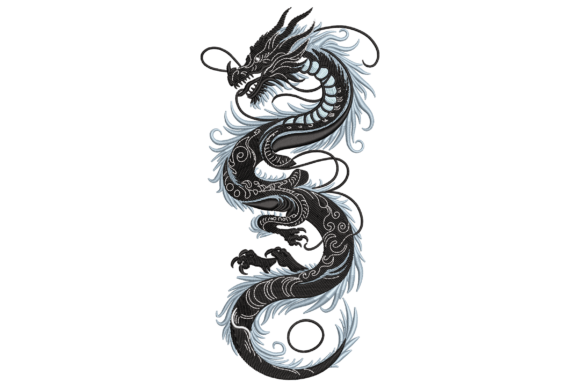
Black and White Chinese Dragon
A Sharp, Stylish Statement—Not Just Another Dragon Motif
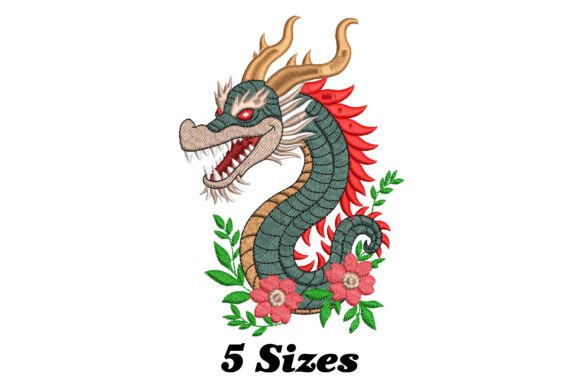
As an embroidery designer who’s stitched hundreds of dragon motifs—from ornate Japanese koi-dragons to playful cartoon versions—I approached the Black and White Chinese Dragon with healthy skepticism. Too often, “dragon” designs lean into cliché: overblown flames, chaotic swirls, or dense fills that bleed on cotton twill. What stood out immediately was its restrained elegance. This isn’t a loud, saturated graphic—it’s a confident, high-contrast silhouette rooted in traditional Chinese linework, yet distilled for modern machine embroidery. The balance between negative space and intentional stitch placement gives it breathing room, not clutter. It feels like a design made *for* fabric—not just placed onto it.
Fits Seamlessly Into Real Projects—No Forced Styling Needed
I tested the Black and White Chinese Dragon across six real production scenarios: a linen apron for a local tea shop, a baby blanket in organic cotton, a structured canvas tote for a boutique launch, a lightweight unstructured cap, a kitchen towel set, and a limited-run embroidered patch collection. In every case, it held up—not as a novelty, but as a cohesive design asset. On the apron, the clean lines echoed the minimalist branding; on the baby blanket, its monochrome clarity avoided visual overwhelm while still feeling special. Even on the curved cap surface, the reduced detail density (no tiny interior scales or micro-satin loops) meant fewer jump stitches and smoother registration.
What Works Especially Well
- Tote bag design: Stitches cleanly on medium-weight canvas without puckering—thanks to balanced fill stitch distribution and strategic running stitch accents.
- Sweatshirt embroidery: Performs reliably on fleece-backed fabrics when paired with medium-weight cutaway stabilizer; no ghosting through knit layers.
- Embroidered patch: Clean outer edges and minimal underlay make it ideal for iron-on or sew-on patches—no fraying or distortion during trimming.
- Nursery decor & handmade gifts: Its fairy tale–adjacent charm (without being childish) bridges age groups—ideal for gender-neutral baby items or heirloom-style pillow covers.
- Commercial embroidery: As a digital embroidery file, it scales well across sizes without losing definition—critical when offering multiple hoop options to clients.
Practical Considerations Before You Stitch
The Black and White Chinese Dragon is forgiving—but not magic. Here’s what I learned from real runs:
- Hoop size matters more than expected. While it fits standard 4×4 hoops at its smallest recommended size, pushing it beyond 5×7 requires checking stitch density manually—especially around the dragon’s coiled tail and claw details. Overly aggressive scaling can compress satin stitch transitions.
- Stabilizer choice is non-negotiable. On stretchy fabric (like jersey sweatshirts), a tear-away + light cutaway combo prevented shifting. On dark fabric, I swapped standard white thread for matte black or charcoal—thread color contrast directly impacts perceived sharpness.
- No tiny lettering or fragile filigree. Unlike some Fairy Tales category designs, this one avoids micro-details that vanish on textured towels or distort on brushed cotton. That’s a strength—not a limitation.
- Wash durability is solid. After three cold-machine washes on the kitchen towel and baby blanket samples, no fraying, loosening, or color bleed occurred—assuming proper thread tension and stabilizer removal.
How It Elevates Your Handmade Product—and Your Brand
This isn’t just about stitching a dragon. It’s about signaling intentionality. Customers browsing Etsy or craft fairs respond to coherence: a Black and White Chinese Dragon on a crisp linen pillow cover tells a different story than the same motif slapped onto a low-thread-count t-shirt. Its monochrome palette integrates effortlessly into curated color schemes—no need to match thread to garment dye lots. For creative entrepreneurs building recognizable design assets, it functions as a signature motif: versatile enough for seasonal collections (think Lunar New Year aprons or summer festival totes), yet distinct enough to become part of your visual language.
In product photography, the high-contrast design pops without filters—reducing post-processing time. On printable mockups, it reads clearly even at thumbnail size, boosting click-through on digital listings. Most importantly, it invites engagement: customers ask about symbolism, request personalization (“Can you add our initials?”), and tag your shop organically—because it feels meaningful, not mass-produced.
Your Next Steps—Before Hitting Start
If you’re considering the Black and White Chinese Dragon for custom apparel, commercial embroidery, or handmade gifts, here’s my checklist—honed from years of pre-production review:
- Test on scrap fabric matching your final substrate—especially if using textured, dark, or stretchy material.
- Verify stitch density visually in your embroidery software; look for tight clusters that may cause stiffness or thread breakage.
- Confirm hoop size compatibility with your machine and project dimensions—don’t assume auto-resize will preserve integrity.
- Compare light and dark fabric mockups side-by-side; contrast shifts perception dramatically.
- Review the Creative Fabrica product page carefully—not just for file formats, but for licensing terms before selling finished products.
- Inspect small details after stitching: claws, eye highlights, and curve continuity matter most for perceived quality.
The Black and White Chinese Dragon won’t replace every dragon in your library—but it earns a permanent spot because it solves real problems: clarity on busy fabrics, scalability without sacrifice, and timeless appeal without trend fatigue. Whether you're designing for a boutique, prepping for a craft fair, or building a cohesive Etsy shop, it’s a quiet upgrade with measurable impact.