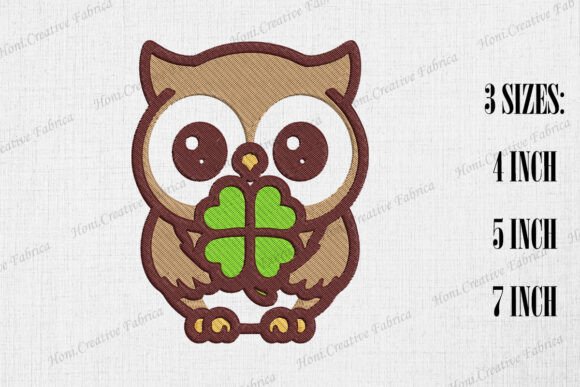
Cute Owl and Clover Embroidery Design
First Impressions: Whimsy with Quiet Confidence
As an embroidery designer who’s stitched for boutique brands from Portland to Dublin, my first glance at Cute Owl and Clover tells me this isn’t just another clip-art motif. It lands somewhere between storybook charm and modern minimalism—soft curves, balanced negative space, and a gentle asymmetry that suggests hand-drawn intention. The owl feels approachable, not cutesy; the clover adds quiet symbolism without clutter. There’s no aggressive fill stitching or over-engineered detail—this is clearly built for readability at 3–4 inches, which makes it ideal for chest placement on sweatshirts. It breathes. And in commercial embroidery, breathing space is where premium perception begins.
Sweatshirt Embroidery That Elevates Neutral Palettes
For our limited drop—a curated set of heavyweight organic cotton sweatshirts in oat, charcoal, and heather sage—Cute Owl and Clover performed exactly as hoped. On oat, we used ecru thread for a tonal whisper; on charcoal, crisp white thread created gentle contrast without shouting. Pastel heathers? A pale mint thread gave it springtime softness while maintaining clarity. What stood out was how the design *settled* into the fabric texture—not fighting the looped surface, but complementing it. That’s rare in bird-themed embroidery files: many owls get lost in pile or bleed at edges. Cute Owl and Clover avoids that with intentional stitch direction and moderate stitch density—enough coverage to hold shape through washing, but light enough to drape naturally across curved seams and ribbed cuffs.
Hoodie Design Versatility Beyond the Chest
We tested Cute Owl and Clover in three placements: classic left-chest (2.75" wide), sleeve cuff accent (1.5"), and centered back yoke (4"). All worked. The chest version read instantly—even at arm’s length—thanks to clean outer contours and distinct clover leaf separation. The sleeve iteration surprised us: scaled down, it kept its personality. No pixelation, no thread nesting. That tells me the original digitizing respected small-size integrity, a must for Etsy sellers offering custom sizing. For oversized hoodies, we floated the design slightly higher than usual—not centered on the chest panel, but aligned with the natural shoulder slope. It felt intentional, not accidental. That kind of subtle spatial intelligence separates boutique brand assets from generic design assets.
Thread Colors & Fabric Thickness: Practical Notes
This machine embroidery design responds beautifully to thoughtful thread selection. On dark fabric, avoid pastel threads unless you’re aiming for deliberate subtlety—go for high-contrast matte polyester (not rayon) to prevent shine that competes with cozy texture. For lightweight knits or baby onesies, reduce top tension slightly and use tear-away + cut-away stabilizer combo—Cute Owl and Clover has enough open areas to benefit from dual support without stiffness. On heavy fleece or French terry? Stick with medium-weight cut-away only; too much stabilizer kills drape. Remember: sweatshirt embroidery isn’t about maximum coverage—it’s about harmony between thread, fabric, and wearability.
Commercial Embroidery Readiness: What You’ll Want to Confirm
Cute Owl and Clover feels commercially viable—no jagged jump stitches, no floating elements prone to snagging, and no tiny interior details that vanish at production scale. That said, always verify the embroidery file includes multiple hoop size options before bulk stitching. If your shop uses 4x4 hoops exclusively, confirm the design fits comfortably within that boundary with at least ¼" margin. Also check whether the file supports multi-color sequencing cleanly—if you plan to offer thread customization (e.g., “choose your clover color”), inconsistent color stops will slow down your workflow. As a small shop product, consistency across batches matters more than flash. This design delivers that baseline reliability.
Brand Identity & Customer Trust in Handmade Product Context
Here’s what Cute Owl and Clover does quietly but powerfully: it signals care. Not just in execution—but in curation. When customers scroll an Etsy listing and see this embroidered on a relaxed-fit hoodie styled with linen trousers and a ceramic mug, they don’t see “owl design.” They see a lifestyle choice. That alignment builds trust faster than any description. For handmade product positioning, Cute Owl and Clover reads as intentional—not algorithm-generated, not trend-chasing. It carries warmth without saccharine overload. That nuance strengthens brand identity for small clothing brands building recognition through repetition: same design, evolving palettes, consistent quality. Over time, that becomes visual shorthand—like a signature.
Design Assets for Real Business Use
Pair Cute Owl and Clover with clean printable mockups—not busy backgrounds—to highlight stitch texture and fabric interaction. Lifestyle photography works best when the embroidery is lit to show dimension, not flatness. For digital embroidery file listings, include notes on recommended stabilizer type and thread weight (e.g., “40wt polyester recommended for cotton blends”). Small shop owners appreciate those details—they reduce trial-and-error and protect reputation. And remember: Birds category shoppers often seek comfort, nostalgia, or nature-connected calm. Cute Owl and Clover delivers that emotionally while staying firmly rooted in Embroidery practicality.
Final Thought: More Than a Pattern—A Boutique Signature
In a market flooded with scalable vectors and AI-generated motifs, Cute Owl and Clover stands out by honoring embroidery’s tactile soul. It doesn’t try to be everything—it’s focused, friendly, and finish-ready. Whether you're an Etsy seller batching 20 hoodies or a local embroidery shop building seasonal collections, this design earns its place in your library not because it’s trendy, but because it’s trustworthy. It stitches cleanly, photographs honestly, and wears well—not just on fabric, but on your brand.