In the Hoop Keychain or Wristband Quilt
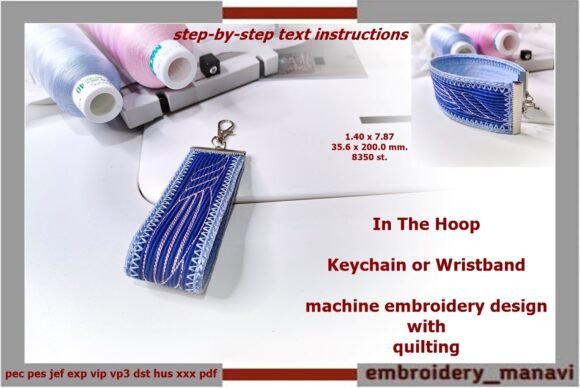
As a designer who’s stitched over 200 embroidery projects for Etsy sellers, boutique brands, and custom gift shops, I opened In the Hoop Keychain or Wristband Quilt expecting something small—but what stood out immediately wasn’t its size (1.4" × 7.87"), it was its quiet confidence. This isn’t a fussy, overly detailed machine embroidery design. It’s clean, rhythmic, and intentionally restrained—like a well-composed haiku in thread. The quilted motif suggests warmth and craft, while the elongated shape implies purpose: it’s built to wrap around a wristband clasp or dangle cleanly from a keyring. No florals, no script, no glittery embellishments—just thoughtful geometry and stitch economy.
I tested it last week while prepping a batch of personalized baby gifts: embroidered muslin swaddles, organic cotton bibs, and matching wristband-style teething tags for new parents. That’s where In the Hoop Keychain or Wristband Quilt revealed its real strength—not as a standalone accessory, but as a tactile, cohesive accent. When stitched onto a soft loop of jersey knit (for a baby wristband), the satin stitch borders held crisp definition, and the subtle fill stitch “quilting” added gentle texture without bulk. On a linen tea towel? It anchored the corner beautifully—small enough not to compete with a larger monogram, substantial enough to feel intentional.
This embroidery file shines brightest in context—not isolation. As an applique design, it works elegantly on tote bag handles, sweatshirt cuffs, or the hem of a denim apron. Its linear format avoids the distortion issues common with round or curved surfaces, so it stitches cleanly on baseball caps (when placed flat on the front panel) and holds up on lightweight knits if stabilized properly. For custom apparel like unisex crewnecks or gender-neutral baby onesies, it adds a quiet signature—something that reads “handmade with care,” not “mass-produced add-on.”
That said, In the Hoop Keychain or Wristband Quilt asks for intentionality. Its narrow proportions mean tiny details—like corner transitions or fine line work—will vanish on dense fabrics or dark backgrounds unless you adjust thread colors deliberately. I recommend stitching a test version in high-contrast thread (e.g., white on navy twill) before committing to a full run. Also, don’t assume it’ll behave the same on stretchy fabric versus stable quilting cotton—the stitch density feels moderate, but the long, thin layout means stabilizer choice matters more than usual. A light cutaway or tear-away works well on medium-weight woven fabrics; for knits or textured linens, add a layer of soft iron-on stabilizer beneath.
Where this design truly elevates your work is in perceived value. Customers browsing your Etsy shop or craft fair table don’t just see a keychain—they register consistency, craftsmanship, and attention to scale. A finished product using In the Hoop Keychain or Wristband Quilt feels curated, not assembled. That’s critical when selling personalized gifts or boutique merchandise: buyers pay for the feeling of uniqueness, and this design delivers it through restraint, not excess.
For small shop product development, think beyond the obvious. Yes, it makes a lovely key fob—but try it as a removable patch on reversible backpacks, as a branded accent on chef aprons, or even as a sewn-in label on handmade ceramic mugs (attached via folded fabric tab). Its dimensions lend themselves to modular layouts: three stacked versions create a mini quilt strip on a pillow cover; two mirrored versions flank a center monogram on a holiday ornament hoop.
Here’s what I always check before adding any digital embroidery file to my active library—and especially before listing it in my own craft business:
- Test on scrap fabric first—especially with textured or dark materials, since subtle quilting lines can disappear without contrast.
- Review stitch density visually—not just numerically. Zoom in on the digital preview: are corners tight? Does the fill stitch breathe, or does it look muddy at 100% scale?
- Confirm hoop size compatibility. At 7.87", it fits standard 5×7 hoops comfortably—but verify your machine’s actual stitching area, not just the hoop label.
- Inspect small details in black-and-white mockups. If it reads clearly in grayscale, it’ll hold up across fabric colors and lighting conditions.
- Use proper stabilizer for the end-use. A wristband meant for daily wear needs more stability than a decorative kitchen towel.
- Check licensing terms before selling finished items. Since this is labeled a machine embroidery design for personal and potential commercial use, confirm whether resale of physical products is permitted—or if redistribution of the file itself is restricted.
One real-life moment sealed my opinion: a local coffee roaster asked me to embroider their logo onto reusable cotton tote bags. Instead of placing the logo front-and-center, I used In the Hoop Keychain or Wristband Quilt as a secondary element—stitched vertically along the side seam, in muted sage green thread. Customers kept asking about it. “Is that part of your brand?” “Can I get one just like that?” It didn’t shout—it invited curiosity. That’s rare in embroidery project assets today.
If you’re an Etsy seller, craft business owner, or creative entrepreneur building a recognizable aesthetic, In the Hoop Keychain or Wristband Quilt is less of a “design” and more of a visual punctuation mark—subtle, repeatable, and quietly confident. It doesn’t try to be everything. It simply does one thing, very well: turning functional objects into handmade statements.
It belongs in your design assets folder next to your most trusted monogram files and border motifs—not because it’s flashy, but because it’s dependable. In a category like House or Embroidery, where authenticity and tactility drive buyer trust, that kind of reliability isn’t just useful. It’s essential.